CASE STUDY
All case studiesFrom Unanswered Patient Calls to Booked Dental Appointments
How a dental practice used a conversational AI phone agent to manage patient enquiries, book appointments, follow up on cancellations and support its reception team beyond normal working hours.
01THE CHALLENGE
Every unanswered call was a potential appointment the practice couldn't capture.
The practice depended heavily on its receptionist for telephone communication. That same person also supported everyday clinic operations, greeted patients and assisted with administrative work. When several responsibilities demanded attention at once, answering the phone was not always possible.
A patient standing at reception needed attention, a dentist required assistance and another patient might want to change an appointment. All of these situations competed with incoming calls. The practice could not simply abandon patient-facing duties to answer every enquiry, yet missed calls represented potential appointments and an interrupted patient experience.
Patients do not always look for dental appointments during clinic hours. Some call in the evening or over the weekend, when nobody is available to answer. The existing voicemail process could record a message, but it could not check availability, answer routine booking questions or reserve an appointment.
The receptionist also managed appointment confirmations and reminder calls. During busy periods, these administrative tasks were easy to postpone. A cancellation could leave an opening in the schedule, while another patient waiting for an earlier appointment might never learn that a slot had become available.
The practice needed to separate routine telephone administration from the patient-facing work that required someone physically present. The opportunity was not to replace the reception team, but to give it a reliable system for handling predictable calls, appointment changes and follow-up tasks.
02WHAT WE BUILT
An AI phone agent connected to the practice's scheduling and patient communication workflows.
We implemented a conversational Voice AI system designed around the types of calls a dental reception team handles every day. Rather than providing a generic answering service, the system connects spoken patient requests to appointment information and predefined operational actions.
The voice agent answers incoming telephone enquiries, including after-hours calls and calls that reach the automated overflow route when reception staff are occupied. Patients can speak naturally about why they are calling, and the agent supports common requests such as booking an appointment, checking availability, confirming a visit, rescheduling or asking routine questions about the practice's services.
The voice agent connects to the practice's appointment management system and calendar. It can check available appointment slots during a conversation, complete supported booking actions and identify alternative availability when a patient needs to change an appointment.
Automated patient follow-up reduces dependence on manual reminder calls. The workflow contacts patients ahead of scheduled appointments and supports confirmation or rescheduling. If someone indicates they cannot attend, the system can move the conversation into the appropriate appointment-change process rather than leaving the issue for reception staff to discover later.
The automation supports cancellation handling and appointment recovery. When a slot becomes available, the workflow can identify relevant waitlisted patients and initiate follow-up to offer the opening, connecting appointment changes with the practice's existing scheduling process.
Not every telephone enquiry should be completed by AI. Calls involving urgent dental concerns, uncertain requests or situations outside the approved workflow are routed for appropriate human attention. The system also records call outcomes and summaries for staff review, helping the reception team understand which appointments were handled and which conversations need follow-up.
The result is a connected telephone workflow in which routine scheduling actions are automated while clinical judgment and exceptional situations remain with qualified people.
03HOW IT WORKS
Two connected workflows handle incoming calls and appointment follow-up.
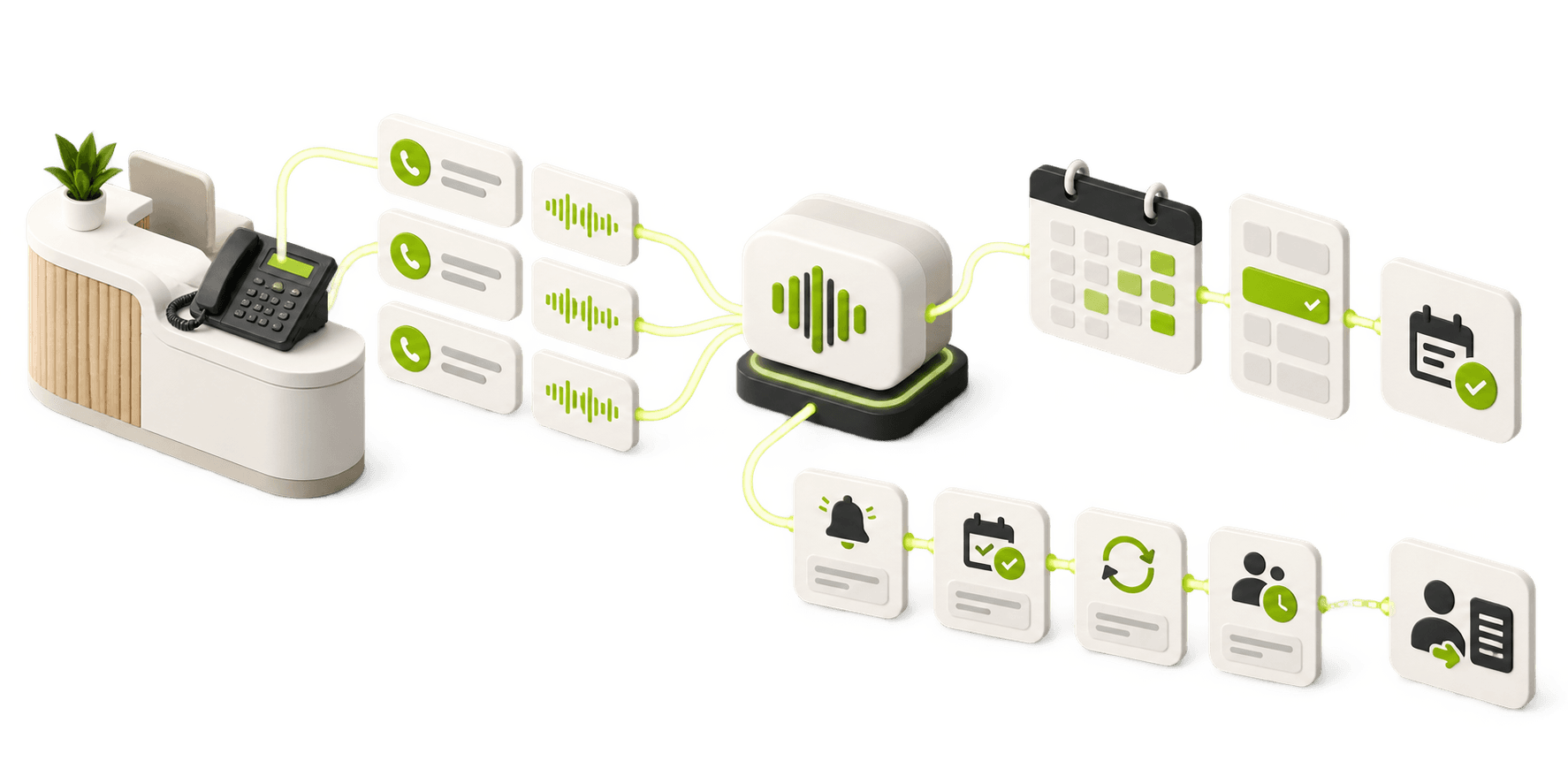
Workflow A handles inbound patient calls. Workflow B handles scheduled reminders, confirmations, cancellations and waitlist follow-up. These are connected operational branches, not one strictly sequential automation; booking and human escalation remain conditional alternatives where appropriate.
- 01
A · Answer the Incoming Enquiry
When a patient calls, the phone workflow determines whether the AI receptionist should handle the enquiry, including configured overflow periods and outside normal opening hours. The agent begins a natural spoken conversation to understand the reason for the call.
- 02
A · Understand & Retrieve Availability
The agent identifies whether the patient wants to book, confirm, cancel or change an appointment, or ask a routine question. For scheduling requests, it checks the connected practice calendar for relevant availability.
- 03
A · Complete or Escalate
For supported requests, the agent can offer appointment options and carry out the appropriate booking or rescheduling action. Urgent concerns or requests requiring professional judgment follow the defined human escalation path instead of a clinical decision.
- 04
B · Contact Patients Before Appointments
A separate automated process identifies scheduled appointments requiring reminders or confirmation, contacts patients, collects responses and updates the relevant appointment status through the connected process.
- 05
B · Recover Openings & Inform Reception
When a patient cancels or requests a different appointment, the system handles the scheduling update and can initiate waitlist follow-up for the newly available slot. Call records and outcomes are made available to reception for review and human follow-up.
04THE IMPACT
Patient enquiries no longer had to depend entirely on one busy reception desk.
The implemented system changed how routine telephone and scheduling work could be handled. These benefits describe operational capabilities; project-specific numerical improvements remain unconfirmed.
More dependable telephone coverage
The AI receptionist provides another way to answer routine patient enquiries when staff are occupied and outside normal clinic hours.
Appointment booking beyond opening hours
Patients can explore available times and complete supported scheduling requests without waiting for the reception desk to reopen.
Less repetitive telephone administration
Routine enquiries, appointment confirmations and scheduling changes can be handled through automation, allowing reception staff to focus more attention on patients inside the practice and situations that need human assistance.
A more responsive cancellation process
Cancelled appointments can trigger follow-up actions rather than depending entirely on someone noticing an empty calendar slot and manually calling patients on a waitlist.
Clearer separation between automation and clinical responsibility
The system handles defined administrative interactions and routes sensitive or uncertain cases to people. Clinical assessment, treatment decisions and situations requiring professional judgment remain outside the AI receptionist's authority.
05KEY TAKEAWAYS
Reliable dental appointment automation supports the front desk without crossing clinical boundaries.
- 01
The front desk does not need to personally handle every routine phone call
A busy reception team performs many tasks that require human attention. Automating predictable telephone enquiries can make the overall workflow easier to manage.
- 02
Voice AI becomes more useful when it can act on real scheduling information
Answering questions is only part of the job. Connecting the agent to appointment availability and booking actions allows patients to complete practical requests during the conversation.
- 03
Appointment recovery deserves as much attention as appointment booking
Confirmations, cancellations and waitlist coordination are connected parts of the same operational process. Automating those handoffs helps the practice respond when availability changes.
- 04
Administrative automation must respect clinical boundaries
AI can manage defined scheduling and communication tasks, but urgent concerns and clinical decisions require appropriately qualified human involvement.
06NEXT STEP
How many patient enquiries depend on someone being available to answer the phone?
If your dental practice is managing high call volumes, manual reminders, missed enquiries or recurring appointment changes, there may be an opportunity to make these workflows more dependable without adding unnecessary administrative complexity. At 99xAutomation, we design and implement AI systems around existing business operations, connecting practical automation with the people and processes already in place.