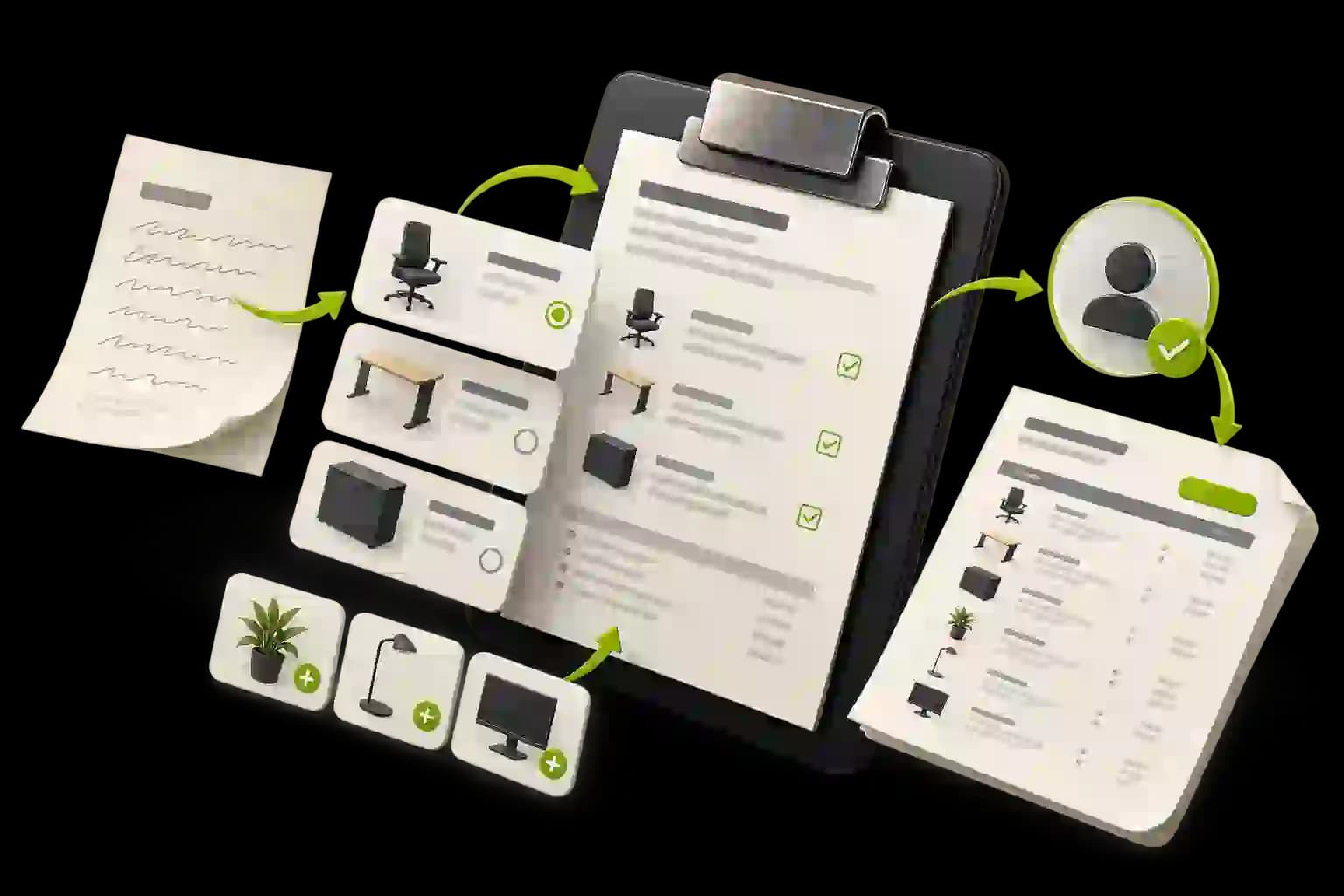
CASE STUDY / SERVICE BUSINESS
All case studiesFrom Expert-Dependent Quoting to AI-Assisted Order Preparation
How a project-based service business implemented an AI agent that handled 50–70% of standard equipment selection during its pilot, preparing inventory-grounded draft orders while keeping specialists responsible for final decisions.
01THE CHALLENGE
Growing service demand was creating more work for the people whose expertise mattered most.
The business delivered customized projects that required experienced staff to translate customer requests into practical equipment and resource requirements.
A seemingly straightforward customer enquiry could involve several decisions about technical specifications, equipment combinations, project scope and inventory selection.
Those decisions were essential to delivering the service correctly, but not every part of the process required the same level of expert judgment.
Every new enquiry started with substantial manual preparation. Customer requirements often arrived as descriptions of what the customer wanted to achieve rather than as a complete technical specification. Staff had to interpret those requests, determine the relevant equipment and construct detailed orders with numerous inventory line items. Even when projects shared common requirements, much of the equipment-selection process was repeated manually. This made preparing a new order time-consuming before the team could focus on its more specialized elements.
Experienced staff had become the operational bottleneck. Senior employees understood which equipment combinations worked for different situations, how to translate vague requirements and which exceptions needed special consideration. But that expertise was difficult to reuse consistently. Much of the decision-making knowledge existed in individual employees' experience rather than in a structured process that other team members could readily apply. As the volume of enquiries increased, the business remained heavily dependent on the availability of those specialists.
Routine equipment selection competed with creative work. The company differentiated itself through customized service delivery, technical problem-solving and its ability to translate customer expectations into practical solutions. Those activities required human creativity and judgment. However, the same employees were also responsible for selecting standard equipment, entering inventory items and assembling the repetitive portions of orders. Time spent repeating predictable selections was time not available for more valuable client-facing and project-design work.
The company needed greater capacity without removing expert control. Fully automating complex project decisions would have introduced unnecessary risk. The business needed a more selective approach: automate recurring preparation, make use of existing inventory information and reserve the final design and approval decisions for experienced people. The opportunity was to change where specialists spent their time, not remove them from the process.
02WHAT WE BUILT
An AI agent that prepares inventory-grounded draft orders for expert review.
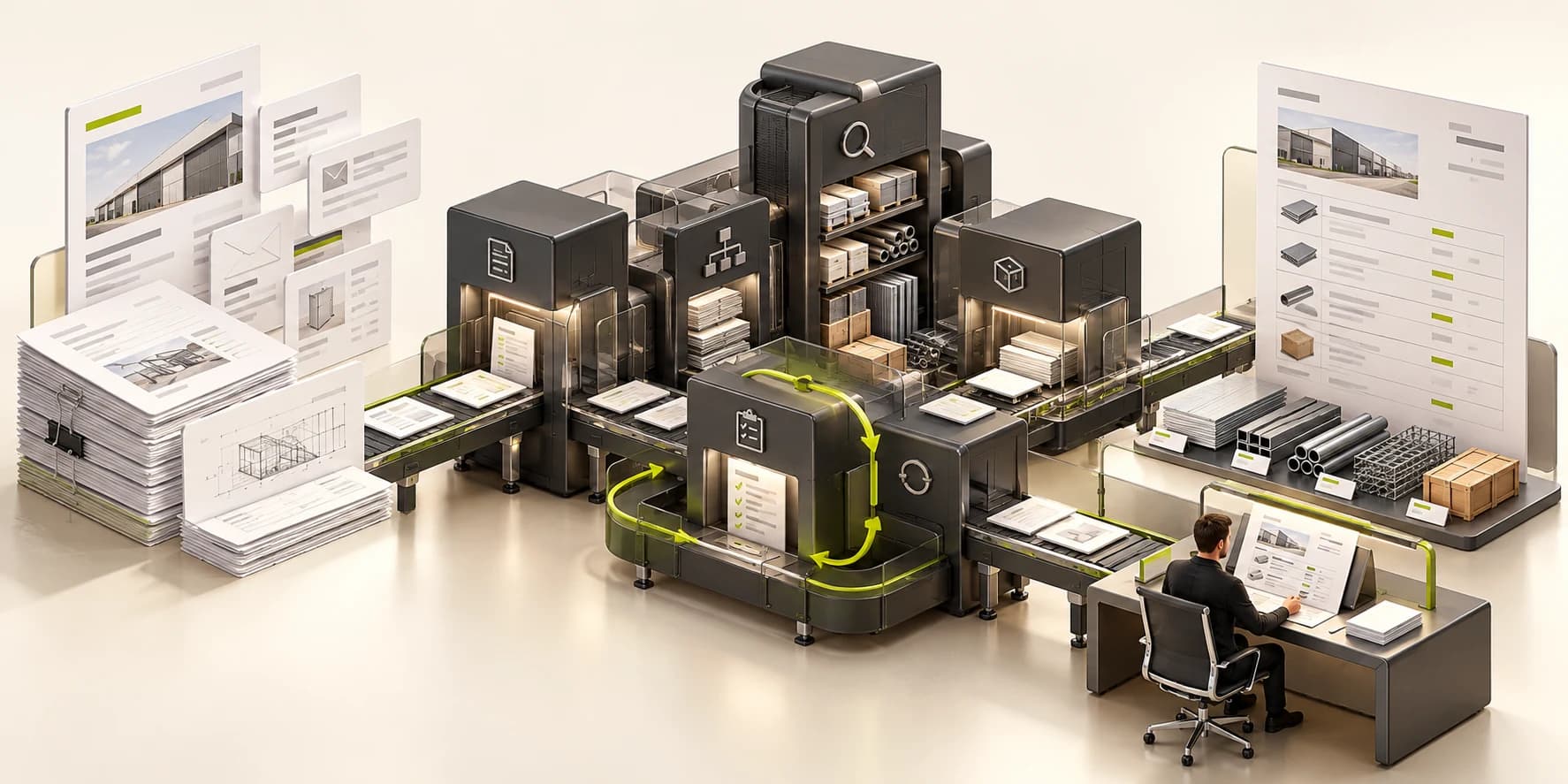
We implemented an AI-assisted pre-sales workflow designed to turn customer requirements into a structured starting point for technical order preparation.
The system combines contextual information, multi-step AI reasoning, inventory validation and human review.
Context-aware customer requirement processing: The workflow brings together relevant information from customer communications and supported project documents, including structured files, PDFs and email correspondence. Instead of requiring employees to manually reconstruct all the requirements before starting an order, the AI agent uses the available project context to identify relevant needs and prepare the next stages of processing. This provides a more consistent starting point for equipment selection.
Multi-step agentic order preparation: We implemented an AI workflow that can work through several interconnected decisions rather than generating an order in a single response. The agent breaks down the available requirements, processes relevant details and selects appropriate actions for developing the draft. When additional evaluation is needed, the workflow can revisit earlier decisions or follow an alternative processing path. This iterative approach reflects the fact that technical orders often require several dependent decisions.
Inventory-grounded equipment selection: The system connects to the business's existing inventory and order-management environment. Equipment recommendations are grounded in the company's actual inventory records rather than freely generated product descriptions. The workflow maps proposed items to valid inventory references, supporting the preparation of draft orders that staff can review against the operational system. This keeps the AI's recommendations connected to the equipment catalog the business uses.
Validation of generated order details: The workflow includes defined validation checks to identify unsuitable or inconsistent outputs before they reach the final approval stage. Inventory references and proposed order details are checked against configured requirements. Items requiring further judgment remain visible for specialist review. These checks help constrain AI-generated suggestions, although they do not eliminate the need for professional verification.
Human-in-the-loop order finalization: The AI agent prepares the recurring portions of an order, but experienced employees retain responsibility for the final result. Specialists review the proposed equipment, adjust configurations, handle unusual requirements and apply their technical and creative judgment. The prepared order is a starting point, not an automatically approved commitment to the customer. This separation allows the business to automate predictable preparation while preserving the expertise required for customized service delivery.
03HOW IT WORKS
From a customer request to a structured draft order, with expert decisions preserved.
The system operates as an iterative agentic workflow. It can revisit earlier decisions when needed, rather than following one rigid sequence from beginning to end. The five stages explain the operating process while preserving conditional paths: incomplete information can trigger further processing or human clarification; uncertain inventory selections can be revisited or flagged; and specialists can adjust the draft before final approval. The result is a pre-sales workflow that begins with structured AI preparation while keeping specialist decision-making at the point where it matters.
- 01
Gather customer requirements and project context
The workflow receives the available customer brief and supporting information from configured sources. This can include customer correspondence, structured data and project documents containing the requirements needed to begin order preparation. The information provides the context for subsequent equipment-selection decisions.
- 02
Interpret requirements and plan the draft order
The AI agent analyzes the supplied information to identify relevant project needs. It separates the requirements into smaller decisions and determines which processing steps are needed to prepare a suitable equipment selection. Where requirements are incomplete or uncertain, the draft may need further processing or human clarification.
- 03
Select equipment from the existing inventory
The agent works with the company's inventory records to identify relevant standard items. Proposed equipment is mapped to actual inventory references, keeping the generated draft connected to the operational catalog. The system builds the routine portions of the order rather than generating an unrestricted list of imagined products.
- 04
Validate selections and revisit uncertain decisions
The proposed order details are checked against configured validation rules and inventory information. When a selection is inconsistent, incomplete or unsuitable, the workflow can revisit the relevant decision or identify the issue for expert attention. This is an iterative checkpoint, not a guarantee that every generated recommendation is correct.
- 05
Present the draft for specialist review
The AI-prepared order is made available to the responsible employee. The specialist reviews the selected items, makes necessary adjustments and completes the creative or technically complex portions of the work. Final validation and approval remain with the human team before the order proceeds through the established business process.
04THE IMPACT
The AI pilot handled 50–70% of standard equipment selection.
The implemented pilot automated a substantial portion of routine equipment selection, giving specialists a structured draft order instead of requiring them to build every order from scratch. Experienced employees continued reviewing equipment recommendations, adjusting complex configurations and approving final orders. The operational shift is straightforward: AI prepares the repeatable work; experienced people remain responsible for the decisions that define service quality.
A structured starting point for new orders
Instead of beginning every customer request with an empty order, specialists can review an AI-prepared selection of relevant inventory items. This changes the work from entirely manual preparation toward review, adjustment and completion.
Reusable operational knowledge
Recurring equipment-selection patterns and validation requirements are represented within the automated process. The business becomes less dependent on individual employees remembering every standard configuration. Expertise remains essential, but more of the repeatable preparation logic is available through the system.
Better use of experienced employees
Routine order preparation can be handled by the AI workflow, giving specialists more opportunity to concentrate on complex configurations, creative solutions and customer requirements that need personal attention. This supports a different division of work between automation and human expertise.
Draft orders grounded in real inventory
The workflow uses the company's operational inventory records rather than relying entirely on generated suggestions. This provides a more practical foundation for preparing orders that will ultimately be reviewed and completed within the existing business process.
A foundation for handling more complex pre-sales work
The agentic architecture allows repeatable decision steps to be structured, validated and revisited when needed. This creates an extensible foundation for additional pre-sales automation without requiring the business to remove human oversight from customized project decisions.
- Of standard equipment selection handled by the AI pilot
- 50–70%
- Verified. User-confirmed achieved pilot result; not a measure of accuracy, quoting speed or total pre-sales automation.
05KEY TAKEAWAYS
AI prepares the repeatable work. Specialists remain responsible for service quality.
- 01
Specialist time is often consumed by work that doesn't require specialist judgment.
Complex service businesses should distinguish between routine preparation and the decisions that genuinely require experience, creativity or technical understanding. Automating the former helps protect time for the latter.
- 02
Useful AI agents need access to real operational information.
Generating plausible equipment suggestions is not the same as preparing an actionable order. Connecting an AI workflow to validated inventory references makes its output more useful for real business operations.
- 03
Human oversight should be designed into the process.
For customized service delivery, AI-generated drafts should support experienced employees rather than bypass their judgment. A clear review point is part of the solution, not a sign that automation has failed.
- 04
Capturing repeatable decisions can help businesses scale expertise.
When standard selection rules and recurring preparation patterns become part of a structured system, experienced employees no longer need to recreate every routine decision manually. That creates opportunities to expand operational capacity while preserving the value of specialist knowledge.
06NEXT STEP
Is your team rebuilding the same customer quotes and orders from scratch?
If experienced employees spend hours translating customer requests into equipment lists, proposals or detailed orders, there may be an opportunity to automate the repeatable preparation while keeping complex decisions in human hands.
At 99xAutomation, we design and implement AI agents around existing business processes, connecting operational data, workflow logic and the people responsible for final decisions.