CASE STUDY / REAL ESTATE
All case studiesFrom Inconsistent Document Uploads to Structured Verification Data
How a real estate business implemented AI-assisted document processing to handle different file types, extract relevant information and prepare structured records for its existing verification process.
01THE CHALLENGE
Every document arrived differently, but the business still needed consistent information.
Every customer document creates work before anyone can verify what it contains.
For a real estate business handling identity documents, property records and supporting paperwork, that work became increasingly repetitive. Customers submitted PDFs, scanned copies and photographs in different layouts and orientations. Employees needed to inspect each file, identify the document type, locate relevant information and transfer details into their working systems.
The challenge wasn't simply reading text. Each document category required a different approach, and inconsistent image quality made automated processing harder.
We implemented a document-processing proof of concept that standardizes incoming files, identifies document structures, applies appropriate extraction methods and transfers captured information into an existing business system.
The result is a more structured way to prepare customer-submitted information for verification, reducing dependence on manual document handling while keeping consequential checks separate from automated extraction.
The real estate business relied on documents submitted by customers to support its operational and verification processes. These could include identification documents, passports, property-related records and other supporting paperwork. Although the information was essential, the documents themselves rarely arrived in a consistent format.
Customer uploads created unpredictable processing work. Some documents arrived as clear PDFs. Others were scanned images or photographs taken against different backgrounds. A document might appear sideways, contain unnecessary surrounding objects or occupy only part of an uploaded image. Before employees could extract the required information, they first had to locate and interpret the document itself. These variations made a straightforward data-entry task more complicated.
Different document types needed different extraction methods. A passport, an identity document and a property record do not share the same layout or information structure. Fields appear in different locations, document designs vary and some information uses specialized formats. Applying one generic extraction method to every upload could produce incomplete or incorrectly interpreted results. The workflow needed to distinguish document categories and process each one appropriately.
Manual checking consumed time before verification could begin. Employees had to inspect submitted files, identify relevant details and enter information into operational records. Much of that work involved preparing the information rather than making a final judgment about the document. When files were inconsistent, additional manual handling was needed simply to make them readable and usable. The business needed to automate this preparation without treating extracted text as proof that a document was genuine or legally valid.
Accuracy mattered because the information supported important decisions. Identity and property-related documents contain information that may influence consequential business processes. Incorrectly extracted fields or misidentified documents could create additional work and potentially affect downstream checks. The implementation therefore needed document-specific processing rather than a generic, one-size-fits-all extraction workflow.
02WHAT WE BUILT
A document-processing pipeline that adapts to the file before extracting its information.
We implemented a proof-of-concept workflow designed to handle varied customer-submitted documents and produce structured information for the business's existing operational environment.
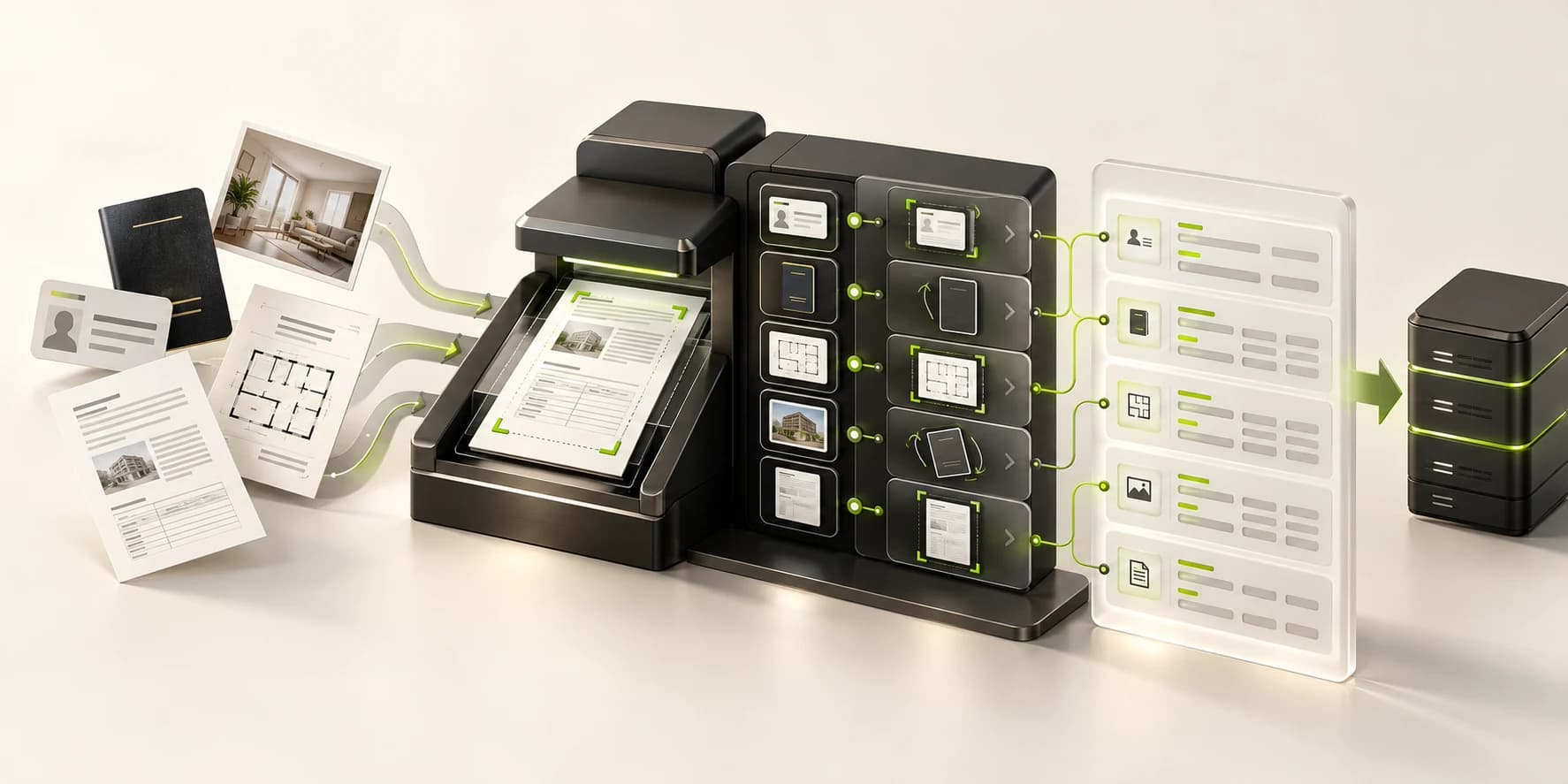
The solution combines file standardization, image cleanup, document identification, type-specific text extraction and data transfer.
Standardized document input: The workflow accepts supported document files and prepares them in a consistent image format for downstream processing. PDFs and image uploads are converted or normalized into supported image representations. This creates a common starting point for subsequent document analysis instead of requiring each extraction stage to handle every original file format differently.
Image detection and orientation correction: We implemented preprocessing steps that locate the document within an uploaded image and isolate it from unnecessary background content. The workflow can crop the relevant region and assess supported orientation problems before extraction. These operations help present the document content in a form better suited to subsequent recognition. The process is concerned with document preparation, not biometric identity matching.
Document-type identification and routing: Different document categories require different handling. The workflow identifies the document category needed for processing and directs supported files through the appropriate extraction approach. This avoids depending on one universal interpretation method for documents with different layouts and field structures.
Document-specific information extraction: The system applies extraction methods suited to each supported document type. For identity and property-related documents, the workflow uses the relevant layout and field structure to identify information. For supported passport documents, specialized recognition handles information contained in the machine-readable section. The objective is to extract information according to the document's actual format rather than treating every file as an identical block of text.
Structured data transfer into the existing workflow: Once the relevant fields have been extracted, the system prepares the information for the business's destination records. The extracted data is transferred into the configured target system, reducing the need for employees to transcribe every supported field manually. This connects document processing with the business's existing operations. The extraction process does not itself establish that the document is authentic, that the information matches an independent authoritative source or that any legal verification requirement has been satisfied.
03HOW IT WORKS
From an uploaded document to structured information in the business system.
The implementation follows a document-processing sequence with different extraction paths for different document categories. The specific recognition method depends on the supported document type.
- 01
Receive and standardize the document
A customer-submitted file enters the configured document-processing workflow. The system prepares supported PDFs, photographs and scanned images in a standardized image representation. This gives subsequent processing stages a more consistent input format.
- 02
Detect, crop and orient the document
The preprocessing service identifies the document region within the image. It removes unnecessary surrounding background and applies supported orientation checks or corrections. This prepares the relevant document content for extraction.
- 03
Identify the document type
The workflow determines which supported document category it is processing. This distinction matters because different documents contain different field structures, visual conventions and extraction requirements. The document is directed to the appropriate processing method.
- 04
Extract information using the appropriate method
The selected extraction process reads relevant information from the document. Standard document fields are handled according to their supported structures, while specialized formats such as the machine-readable section of a passport use an extraction method suited to that format. The resulting information is organized into structured fields.
- 05
Transfer extracted data into the destination system
The workflow passes the extracted information into the configured target environment. The business can then use those records as part of its existing document review and verification process. Automated extraction prepares information for the next stage; it does not independently confirm identity, ownership, document authenticity or legal validity.
04THE IMPACT
Less manual preparation across documents that rarely arrive in the same format.
The implemented proof of concept demonstrated a more consistent approach to preparing and extracting information from varied real estate customer documents. The outcomes below describe established processing capabilities. Specific extraction accuracy, processing speed and time savings have not been independently confirmed for publication. The important change is that the business can automate more of the work required to make submitted documents usable, while keeping document verification as a separate responsibility.
Different file formats can enter a common processing workflow
Supported PDF, image and scanned-document inputs can be standardized before extraction. This reduces the need to treat every original file format as an entirely separate manual preparation task.
Image cleanup becomes part of the process
Document detection, cropping and orientation handling prepare uploaded images for extraction. This addresses common problems created by photographs, background elements and misaligned documents.
Extraction is adapted to the document category
The workflow uses document-specific processing instead of relying on a single method for every type of paperwork. That makes the solution better aligned with the different information structures found in identity and property-related documents.
Structured information reaches the existing business system
Extracted fields can be transferred into configured destination records. This reduces the amount of repeated transcription required to move information from supported documents into operational tools.
A foundation for more consistent document preparation
The proof of concept establishes a repeatable sequence for preparing and extracting information from heterogeneous documents. It provides a foundation for further validation and operational integration without implying that AI has replaced the legal, authenticity or human verification responsibilities associated with real estate transactions.
05KEY TAKEAWAYS
Document AI becomes valuable when preparation and verification stay clearly separated.
- 01
Standardize documents before trying to extract information.
When files arrive in different formats, orientations and layouts, reliable processing begins with preparing the input. Document detection, cropping and orientation handling are practical parts of the automation—not optional decoration.
- 02
Different document types need different processing logic.
A generic text-extraction method may not work equally well for passports, identification documents and property records. Matching the extraction approach to the document category makes the workflow better suited to real operational inputs.
- 03
Data extraction and document verification are different responsibilities.
Reading fields from a document does not prove that the document is genuine or that its contents are legally valid. A responsible system should distinguish information preparation from decisions requiring further evidence or authorized review.
- 04
Document AI becomes more useful when its output reaches existing operations.
Extracted information has more operational value when it can be transferred into the records and tools a business already uses. The goal isn't merely to read documents. It's to reduce repetitive handling between document intake and the next business process.
06NEXT STEP
Is your team still manually sorting, reading and entering customer documents?
If customers submit identity documents, property records or other paperwork in inconsistent formats, there may be an opportunity to automate document preparation and information extraction before the verification process begins.
At 99xAutomation, we design and implement document AI workflows that organize incoming files, extract useful information and connect the results with existing business systems—while keeping consequential checks under appropriate human control.