CASE STUDY
All case studiesFrom Scattered Technical Documents to Answers Employees Can Verify
How an automotive engineering organization connected technical reports, diagrams and spreadsheets into an AI-powered knowledge system that supports complex questions with traceable source evidence.
01THE CHALLENGE
Critical engineering knowledge existed, but finding and connecting it was difficult.
The organization had accumulated extensive technical and operational documentation across different systems and formats.
Historical equipment reports, engineering diagrams, process documentation and structured spreadsheets all held valuable information. But employees often needed to search across several sources to understand a particular issue.
The difficulty wasn't a lack of information. It was the effort required to locate, interpret and connect that information reliably.
Technical documents were more complex than ordinary text. Engineering records frequently contain information that cannot be understood by extracting text alone. A technical report may include several columns, diagrams, annotations and references between different sections. A flowchart communicates meaning through the direction of its connections. An equipment diagram may only make sense when interpreted alongside the surrounding explanation. Conventional document-processing methods can lose those relationships, leaving important context out of search results.
Keyword searches couldn't handle complex engineering questions. Employees weren't always looking for a particular phrase. They might need to identify previous occurrences of a technical failure, compare findings across reports or investigate which components were associated with similar issues. Answering those questions required information from multiple documents, not simply a list of keyword matches.
Spreadsheets and documents were difficult to analyze together. Some relevant knowledge existed in spreadsheets rather than PDF reports. An investigation might require comparing structured records, calculating values and connecting those findings with descriptions from engineering documents. Without a connected analysis process, employees had to move between separate files and perform much of that reasoning manually.
AI-generated answers needed to remain verifiable. A plausible answer is not necessarily a reliable answer, particularly when it concerns technical equipment, engineering incidents or operational decisions. The organization needed more than a conversational interface that could generate confident explanations. It needed a system that retrieved relevant source material, maintained context and made the evidence behind an answer visible to employees.
02WHAT WE BUILT
A modular AI knowledge platform designed around complex documents and evidence-backed reasoning.
We implemented an internal knowledge system with independent processing, search and reasoning capabilities.
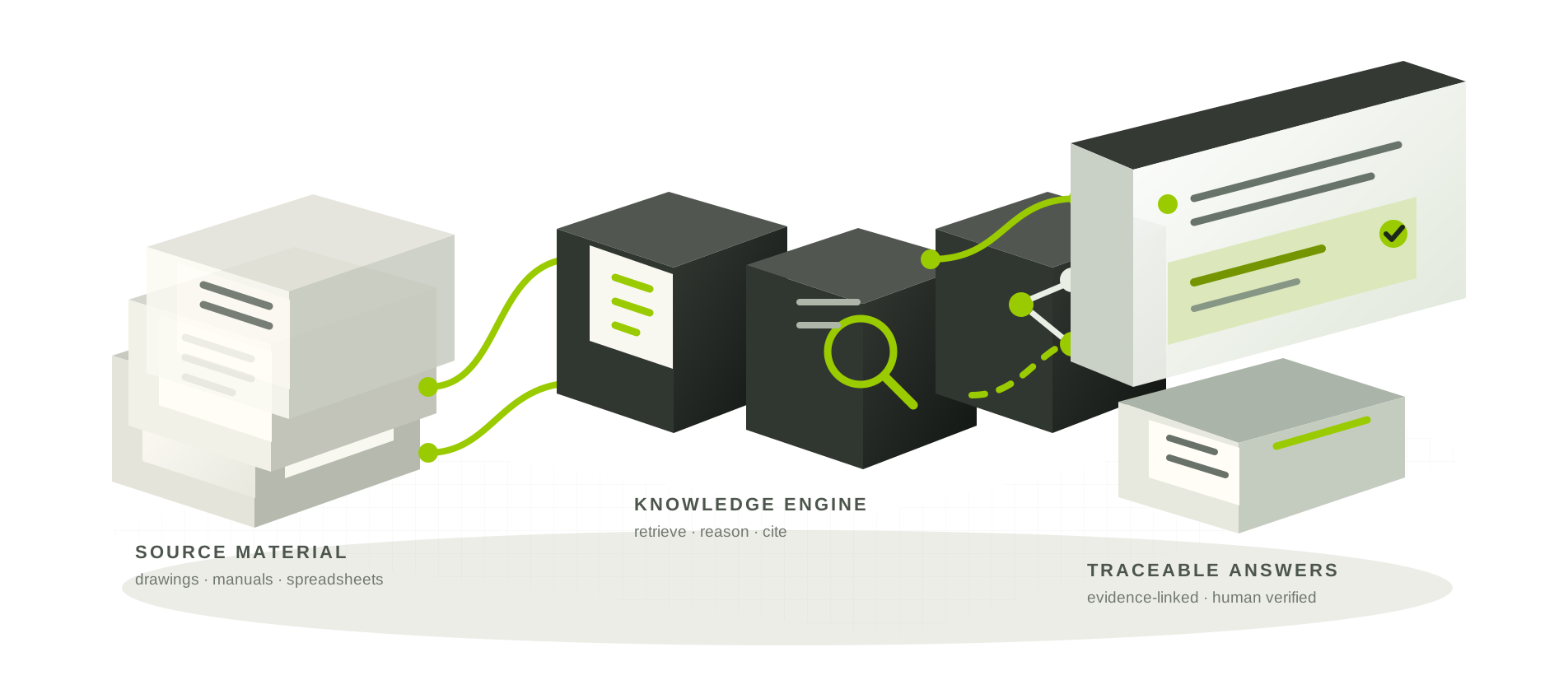
The architecture separates document understanding from information retrieval and AI-assisted analysis. This allows each component to perform a defined task while contributing to a connected employee experience.
Layout-aware document understanding: We built a document-processing module capable of handling complex PDFs, technical drawings, flowcharts and other visually structured information. Rather than treating every page as plain text, the processing workflow interprets document structures and preserves relationships between extracted information and its surrounding context. For critical technical reports, relevant information can be kept together in a more complete structured representation, helping prevent important details from becoming disconnected during retrieval.
Source-traceable knowledge search: A dedicated retrieval service helps employees locate relevant documents using natural-language questions. The system identifies matching source material and exposes the passages associated with the query. This gives users visibility into why particular information was retrieved and allows them to examine the underlying evidence before moving into deeper analysis.
Agentic multi-step reasoning: For questions that require more than direct retrieval, we implemented an AI reasoning service that breaks a request into smaller tasks. Depending on the question, the agent can use appropriate tools to retrieve additional documents, expand technical abbreviations, perform calculations or compare information from multiple sources. The purpose is to make the reasoning process depend on available enterprise evidence rather than unrestricted model-generated assumptions.
Spreadsheet and document analysis: A separate structured-data module supports analysis across spreadsheet files. This allows the system to compare, aggregate and cross-reference data held in worksheets and combine relevant findings with information retrieved from technical documents. Employees can investigate questions involving both written explanations and structured figures through the same broader knowledge workflow.
Modular architecture for evolving requirements: The document parser, search service, reasoning layer and spreadsheet analysis module were built as separate capabilities. This allows individual components to be adjusted or extended as new document types and employee use cases emerge. Instead of rebuilding the entire platform for every additional requirement, the organization has a foundation that can support further internal knowledge workflows.
03HOW IT WORKS
From complex source material to evidence-backed engineering answers.
The system combines document preparation, retrieval and reasoning into a connected process. Spreadsheet analysis operates as an additional capability when a question requires structured data.
- 01
Prepare technical documents and structured information
Engineering reports, technical PDFs, diagrams and other supported documents are processed into searchable representations. The parsing module considers document layout, visual structures and surrounding text so that important relationships are not lost during extraction. Structured spreadsheet information is handled through a separate integration module.
- 02
Find relevant documents and inspect matching evidence
An employee submits a question through the internal knowledge interface. The retrieval service searches the processed information and identifies documents relevant to the request. Matched passages are made visible, allowing the employee to inspect the source material and select relevant documents for further investigation.
- 03
Break complex questions into smaller reasoning tasks
When deeper analysis is requested, the reasoning service decomposes the question into sub-queries. The agent determines which available capabilities are needed, such as additional document retrieval, technical abbreviation expansion, mathematical calculation or comparison across multiple reports. Rather than responding solely from a language model's general knowledge, the workflow uses retrieved information and the outputs of designated tools.
- 04
Connect document evidence with spreadsheet data when needed
For questions requiring structured analysis, the spreadsheet module retrieves and processes relevant worksheet information. The system can compare values across sheets, perform supported calculations and connect those findings with passages from technical documentation. This is a conditional analysis path rather than a mandatory step for every employee query.
- 05
Present a grounded answer with source references
The system brings the relevant retrieved information and tool outputs together into a structured response. Users can examine the source documents and passages that support the answer, making it easier to investigate uncertain details or verify important conclusions. The platform supports employees in finding and interpreting information. Engineering decisions and consequential judgments remain the responsibility of qualified people.
04THE IMPACT
Complex engineering knowledge became easier to search, connect and investigate.
The implementation established a new way for employees to work with technical documentation and structured information. The outcomes below describe the system's implemented capabilities. Exact time savings, retrieval accuracy and other numerical performance improvements have not been independently confirmed for publication.
Natural-language access to technical knowledge
Employees can investigate information held in internal engineering documents without relying entirely on manual file-by-file searches or exact keyword matching.
Better access to diagrams and complex reports
Technical layouts and visual information are included in the document-processing approach, making more of the organization's existing material usable for search and analysis.
Greater transparency behind AI-generated answers
Retrieved source passages remain available for inspection. This helps employees examine how an answer was formed instead of relying solely on a generated summary. Source grounding supports more reliable review, although it does not eliminate the possibility of errors or misinterpretation.
More connected analysis across information formats
Engineering questions can involve both narrative technical reports and structured spreadsheet records. The platform provides a way to work across those sources instead of treating them as entirely separate investigation processes.
An extensible foundation for internal AI use cases
Because parsing, retrieval, reasoning and spreadsheet processing are distinct modules, individual capabilities can evolve without requiring every other part of the platform to be rebuilt. The broader operational value lies in making existing enterprise knowledge easier to use while preserving visibility into the evidence behind important answers.
05KEY TAKEAWAYS
Evidence-backed knowledge systems are built around how information is structured.
- 01
Knowledge retrieval is only as useful as the information it can understand.
Technical documents contain meaning in layouts, diagrams and relationships between sections. Extracting text without preserving that structure can undermine the quality of everything built on top of it.
- 02
Reliable AI answers need visible evidence.
A convincing response is not enough for engineering work. Employees should be able to inspect the original material that supports important claims and conclusions.
- 03
Complex questions require more than similarity search.
Retrieval is useful for finding relevant material, but some investigations also require calculations, cross-document comparisons and structured-data analysis. Connecting specialized tools makes those workflows more useful.
- 04
Modular architecture makes enterprise AI easier to evolve.
Separating document processing, search and reasoning allows new requirements to be addressed without rebuilding the entire knowledge platform.
06NEXT STEP
Is your team's expertise buried across documents, diagrams and spreadsheets?
If employees regularly spend time searching technical reports, comparing records or reconstructing knowledge across disconnected files, a connected AI knowledge system may help make that information more accessible.
At 99xAutomation, we design and implement AI knowledge and workflow systems around existing business information, with practical retrieval, structured analysis and human review.