CASE STUDY
All case studiesFrom Manual CV Screening to Structured AI-Assisted Candidate Reviews
How an AI-powered recruitment workflow helps teams process applications, compare candidate qualifications against job requirements and prepare structured assessments for human review.
01THE CHALLENGE
When applications pile up, meaningful candidate review becomes harder.
Reviewing job applications is essential to recruitment, but the first stage often involves repetitive work: opening documents, extracting information, checking qualifications and comparing each candidate against the same requirements.
Recruitment teams receive applications containing experience, technical skills, educational background, qualifications and suitability information, but this content rarely arrives in a consistent format.
Manual screening consumes valuable time. Recruiters repeatedly open CVs and supporting documents, search for relevant information, compare qualifications and record observations. Much of this work involves information extraction and organization rather than the human judgment required for interviewing and hiring.
Traditional keyword matching can also miss context. A candidate may possess a relevant skill but describe it using different terminology from the job advertisement, while exact phrase matching may prioritize wording without adequately considering meaning.
Inconsistent initial reviews make comparison harder. Under time pressure, assessments may vary in depth and focus, making it harder to explain why candidates were prioritized for further review.
The opportunity was to make the initial screening process more structured without handing final hiring decisions to an automated system.
02WHAT WE BUILT
An AI-assisted screening workflow that organizes applications before recruiters review them.
We implemented an automation designed to transform incoming application documents into structured, role-specific candidate assessments.
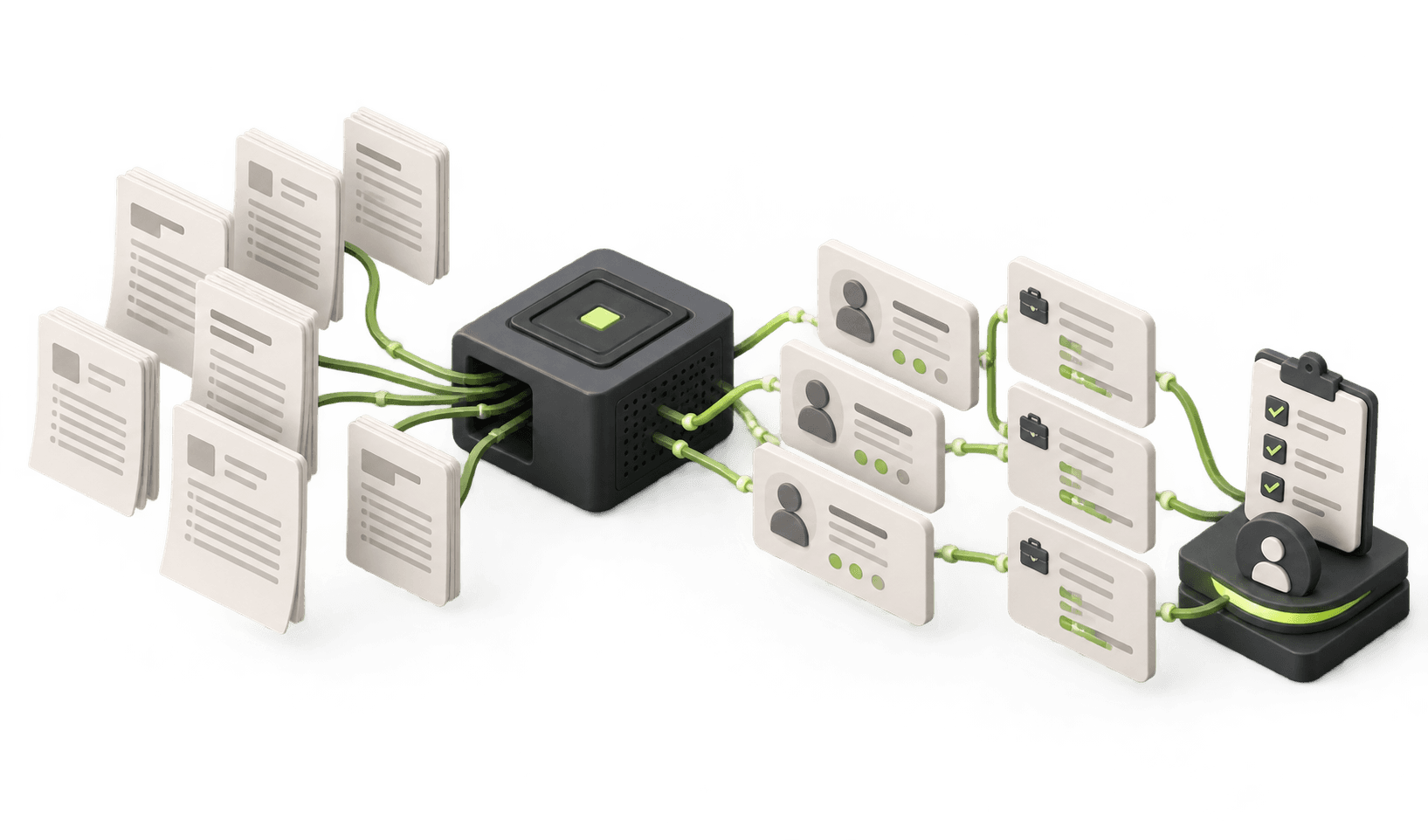
The workflow processes candidate documents, including CVs and relevant supporting information, identifies information relevant to the role and organizes it into a standardized candidate profile.
It extracts professional experience, skills and competencies, educational background, qualifications, employment history and experience duration where identifiable, making applications easier to compare across different document formats.
Candidate information is compared against predefined job criteria, including essential skills, preferred capabilities, experience expectations and qualifications. AI-assisted language interpretation helps identify relevant terminology and equivalent descriptions beyond exact keyword matches.
The resulting assessment organizes relevant evidence against the evaluation criteria instead of producing only an unexplained score or ranking. Recruiters can review the extracted information, examine the assessment and apply their own judgment.
AI prepares the information. Recruiters remain responsible for evaluating candidates and making hiring decisions.
03HOW IT WORKS
From unstructured applications to review-ready candidate assessments.
The workflow follows five main stages, supporting initial preparation while keeping final decisions with the recruitment team.
- 01
Receive Applications
Candidate CVs and supporting documents enter the application-processing workflow.
- 02
Extract & Structure Information
The system organizes relevant experience, skills, qualifications and professional history into a consistent candidate profile.
- 03
Match Against Role Requirements
The structured profile is compared with predefined role-specific criteria, including required qualifications, experience and desirable skills.
- 04
Prepare a Reasoned Assessment
The workflow creates an organized assessment showing how documented qualifications relate to the position's requirements, with supporting explanations.
- 05
Human Review & Decision
Recruiters examine the information, verify relevant findings and determine which candidates should progress. Final decisions remain with the recruitment team.
04THE IMPACT
More structured screening. Less repetitive application processing.
The implementation changes how candidate information is prepared for initial review.
Reduced manual information extraction
Recruiters no longer need to perform every step of reading, extracting and organizing candidate information manually. The workflow prepares structured profiles from incoming application documents.
More consistent application comparisons
Candidate profiles are assessed against defined job requirements, giving recruiters a common structure for reviewing relevant qualifications and experience.
Clearer visibility into candidate suitability
Structured assessments make it easier to identify which documented skills and experiences align with the role and where information may require further verification.
More time for human evaluation
By automating repetitive document processing and preliminary organization, the workflow allows recruiters to focus more attention on reviewing candidates, conducting interviews and making hiring decisions.
Human oversight remains central
The system supports initial assessment and prioritization without replacing recruiter judgment or automatically determining final hiring outcomes.
05KEY TAKEAWAYS
The goal isn't to automate hiring decisions. It's to improve the information behind them.
- 01
Automate repetitive preparation, not professional judgment
AI can help organize documents and compare qualifications while leaving hiring decisions with responsible human reviewers.
- 02
Consistent criteria are more useful than simple keyword searches
Matching candidates against clearly defined job requirements creates a more structured starting point than relying entirely on exact terms found in a CV. Recruiters still need to review the underlying evidence and consider context.
- 03
Explainability matters
An assessment is more useful when recruiters can understand which requirements it addresses and what information supports it. Structured reasoning makes the initial screening process easier to review and challenge.
- 04
Responsible implementation is essential
Recruitment systems handle sensitive personal information and can affect access to employment opportunities. Privacy, appropriate access controls, data retention, human oversight and testing for discriminatory effects must be considered throughout the system's design and operation.
06NEXT STEP
Is your recruitment team spending too much time reviewing applications manually?
If your team handles large application volumes, extracting information, comparing qualifications and preparing candidate summaries may be consuming time that could be spent speaking with applicants. We help businesses identify repetitive administrative processes and implement AI systems that fit their existing operations. From document processing and candidate information management to workflow automation and internal decision support, the goal is to reduce repetitive work while preserving human oversight.