CASE STUDY
All case studiesFrom Exit Interviews to Actionable Offboarding Insight
How an AI-supported offboarding workflow helped turn scattered exit feedback, undocumented know-how and disconnected departure tasks into a more structured HR process.
01THE CHALLENGE
Important offboarding information was being collected, but not turned into operational learning.
Many organizations do conduct exit interviews, but the process is often inconsistent. Different managers ask different questions, responses vary in depth and sensitive feedback may never be compared across multiple departures.
Exit responses were typically recorded as isolated notes, forms or conversations. That made it difficult for HR teams to identify recurring issues, compare themes over time or surface concerns that were appearing repeatedly within particular teams or roles.
In addition to feedback, each departure risked taking undocumented knowledge out of the business. Responsibilities, informal workarounds, open tasks and process knowledge were often not captured in a structured way before the employee's final day.
Beyond the interview itself, HR and IT still needed to coordinate practical offboarding actions such as reminders, handover tracking and access removal. Without a connected process, these steps could become inconsistent or overly manual.
The problem was not simply collecting exit information. It was turning that information into something structured, reusable and operationally useful.
02WHAT WE BUILT
One AI-supported offboarding workflow for interview structure, pattern visibility and knowledge capture.
We implemented a connected process that supports both the people side and the operational side of employee departures.
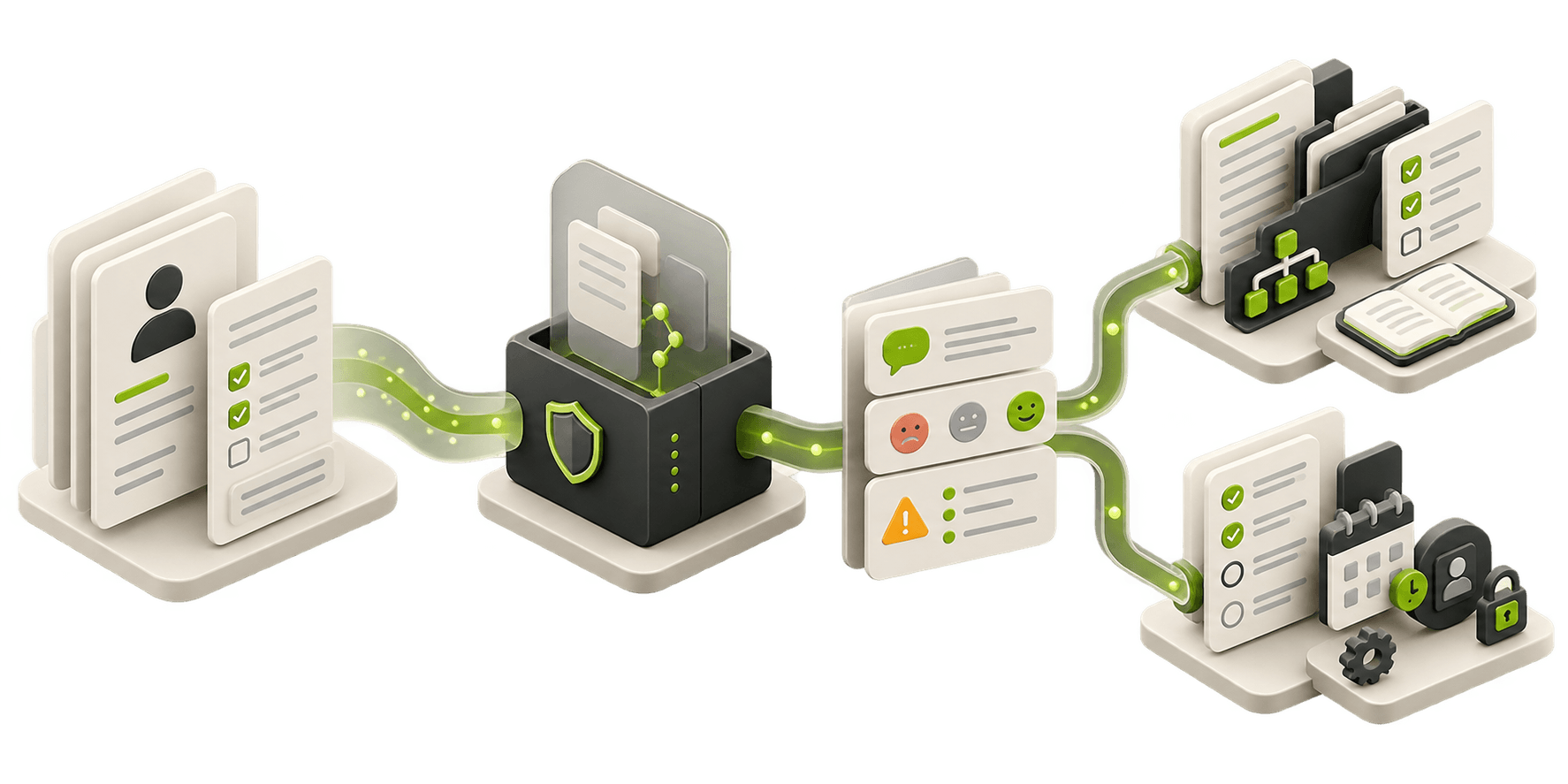
A structured interview or questionnaire format ensures that each departure consistently covers core topics such as reasons for leaving, leadership experience, role expectations, development and working conditions.
Free-text responses are organized into themes and sentiment signals so HR teams do not need to read every answer in isolation. This makes it easier to review recurring concerns and understand the tone behind the feedback.
Instead of treating each resignation as a standalone event, the workflow aggregates feedback across multiple offboarding cases to identify repeated themes. Patterns are surfaced in an anonymized way to support decision-making without exposing individuals unnecessarily.
Based on the departing employee's responsibilities, the system helps initiate a handover structure covering open work, process knowledge, relevant context and items requiring documentation before departure.
The process runs alongside practical offboarding tasks for HR and IT, including reminders, task routing and access-related steps, so that operational completion does not depend on fragmented follow-up.
03HOW IT WORKS
The offboarding process combines structured feedback, aggregated insight and practical transition steps.
The five stages explain the editorial lifecycle. Practical HR and IT offboarding tasks operate in parallel with the feedback and knowledge-transfer processes rather than waiting for every prior activity to complete.
- 01
Trigger the Offboarding Workflow
Once a resignation is confirmed, the system starts the offboarding process and prepares the relevant interview, handover and operational task steps.
- 02
Run a Structured Exit Interview
A standardized interview or questionnaire gathers feedback across agreed core topics, helping ensure consistency from one departure to the next.
- 03
Analyze Responses & Surface Patterns
Feedback is organized into themes and sentiment signals, then reviewed in aggregate to identify recurring concerns, emerging patterns or repeated issues across teams, roles or time periods.
- 04
Initiate Knowledge Transfer
The workflow creates a structured handover outline based on the employee's responsibilities, prompting the capture of open tasks, process notes and knowledge that should not leave with the employee.
- 05
Complete Coordinated Offboarding Actions
In parallel, HR and IT tasks are routed through the process so reminders, approvals and access-related actions are completed in an orderly way before the employee's final day.
04THE IMPACT
A more structured offboarding process with better visibility and less lost context.
The implemented workflow creates qualitative operational benefits without replacing human interpretation, employee context or HR and leadership responsibility.
More consistent exit feedback
Standardized interview structure makes offboarding conversations easier to compare and review over time.
Better visibility into recurring issues
Instead of storing feedback as disconnected records, HR teams receive a more usable view of common themes and repeated concerns across departures.
Stronger knowledge retention
The process helps reduce the risk that undocumented responsibilities, in-flight work and informal know-how disappear without any structured handover.
Better coordination across HR and IT
Operational offboarding steps can be handled through a more consistent workflow rather than relying on ad hoc follow-up.
Human judgment remains central
Sensitive interpretation, employee context and decisions about organizational changes remain with HR and leadership. The system supports evaluation and preparation; it does not replace human responsibility.
05KEY TAKEAWAYS
Offboarding becomes more valuable when feedback becomes visible and knowledge stays with the business.
- 01
Exit interviews create value at the process level
Collecting individual responses is not enough. The real value comes from identifying repeated issues across many departures.
- 02
Offboarding should protect knowledge, not just close accounts
A departure process should include structured handover support so operational knowledge is not lost with the employee.
- 03
Standardization improves comparison and review
Consistent interview structure makes offboarding data easier to interpret and more useful for long-term HR decision-making.
- 04
Sensitive HR workflows need clear human ownership
AI can support analysis, summarization and coordination, but interpretation, intervention and policy decisions should remain with people.
06NEXT STEP
Are employee exits producing insight — or just creating another file no one uses?
If your team is conducting exit interviews, managing handovers and coordinating offboarding tasks manually, there may be an opportunity to make the process more structured, consistent and decision-ready. We help businesses implement AI-supported workflows that connect feedback analysis, knowledge capture and operational coordination while keeping human responsibility at the centre.